Welcome to Bio-X

Welcome to Bio-X

  • Support
  • Contact
  • About
    • Bio-X History
    • Contact Us
    • Clark Center
      • Map & Directions
      • Tours
      • Dining Options
    • Building Services
      • Room Scheduling
      • IT
      • General Facilities Issues
      • Urgent Facilities Issues
      • Non-Emergency Facilities Requests
      • Building Access Request
      • Lab Safety
      • Shared Equipment
    • FAQ
  • People
  • Research
    • Seed Grants
      • Browse Seed Grants
    • Visiting Scholars/Visiting Postdocs
    • PhD Fellows
    • Undergraduate Research
    • Ventures
      • Food@Stanford
      • NeuroVentures
    • Travel Awards
    • Research Partners
    • Browse Videos
    • Browse All Research
  • Highlights
    • Videos
      • Clark Center @ 10x Video
    • Bio-X in the News
  • Videos
    • USRP Faculty Talks
    • Symposium Lectures
    • Additional Videos
  • Events
    • Upcoming Events
    • Archive
    • Talk Videos
  • Get Involved
    • Faculty
    • Students
      • Courses & Workshops
    • Alumni & Friends
    • Corporations
      • Partnership Models
      • Benefits of Partnership
      • Corporate Member Projects
      • Corporate Forum Newsletter Archive
    • Browse Videos
    • Seminar Series
      • Stanford Bio-X Frontiers in Interdisciplinary Biosciences: 2019/2020
    • Support Bio-X
      • Stanford Bio-X White Paper
Image of a thin gold plated wire arcing across a black background.

Soft bioelectronic fiber can track hundreds of biological events simultaneously

Developed by Stanford Bio-X affiliated faculty members Zhenan Bao, James Dunn, Julia Kaltschmidt, and Xiaoke Chen, with co-authors Stanford Bio-X Travel Award recipients Alex Abramson, Ryan Hamnett, Samuel Root, Weilai Yu, Yuanwen Jiang, Jinxing Li, and Weichen Wang, and co-lead authors Stanford Bio-X Travel Award recipient Muhammad Khatib, Stanford Bio-X PhD Fellow Eric Zhao, and Shiyuan Wei, NeuroString is a hair-thin multichannel biosensor and stimulator with promising potential applications in drug delivery, nerve stimulation, smart fabrics, and more. The work was initially launched by a 2018 Stanford Bio-X Interdisciplinary Initiatives Program Seed Grant titled: Closed-loop neurochemical sensing and modulation system for treating psychiatric disorders.
Read more!
View all featured highlights

Bio-X is Stanford's pioneering interdisciplinary biosciences institute, bringing together biomedical and life science researchers, clinicians, engineers, physicists, and computational scientists to unlock the secrets of the human body.

Learn More about Bio-X

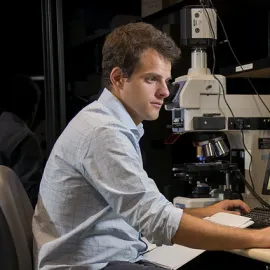
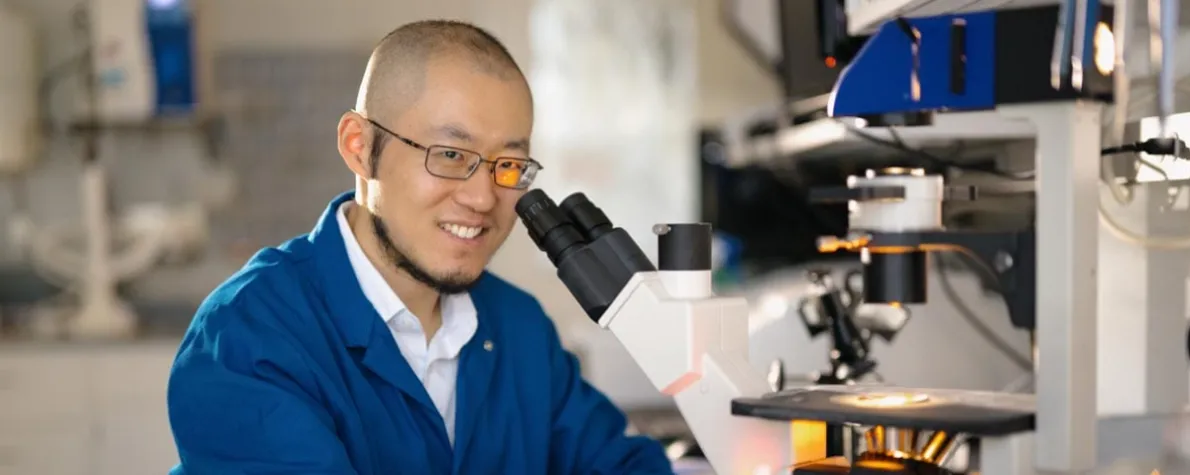
Student looking intent in a lab setting.

Education

Participating in interdisciplinary research prepares students for careers that make an impact in the scientific community.

Watch video
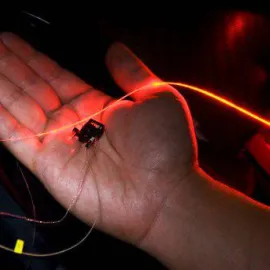
Hand holding small piece of technology.

Innovation

Our pioneering approach to science generates novel technologies for exploring how the body works.

Watch video
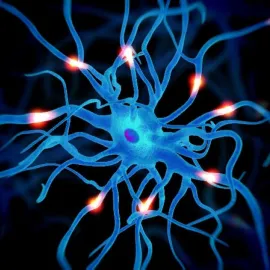
Microscopic detail.

Discovery

Research breakthroughs and technological advances by our collaborative teams advance scientific knowledge.

Watch video
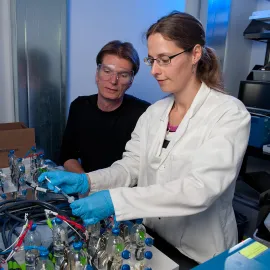
Woman and man in a lab setting.

Collaboration

Our programs bridge disciplines and catalyze discoveries that will ultimately improve human health.

Watch video
  • Attend seminars & symposia
  • Apply for grants & fellowships
  • Support our programs

Stanford Bio-X

James H. Clark Center, Stanford University 318 Campus Drive Stanford, CA 94305 contact-biox@stanford.edu
Follow @StanfordBioX

  • Contact
  • FAQ
  • Room Reservations
Stanford University
  • Stanford Home
  • Maps & Directions
  • Search Stanford
  • Emergency Info
  • Terms of Use
  • Privacy
  • Copyright
  • Trademark
  • Non-Discrimination
  • Accessibility

© Stanford University, Stanford, California 94305