
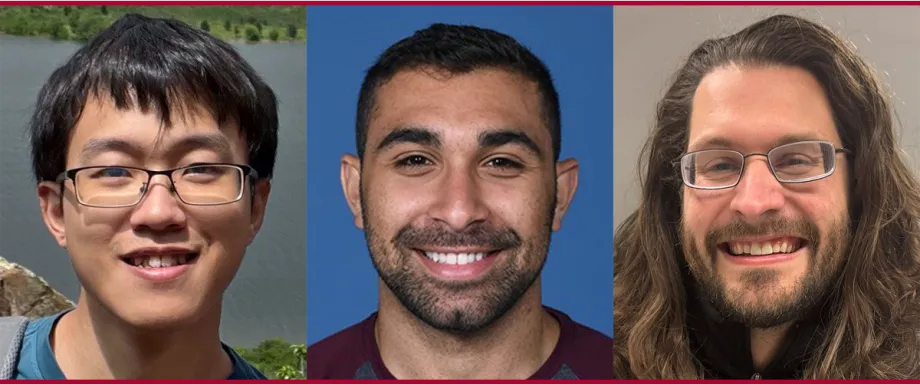
Zhuokun Ding (left), Stelios Papadopoulos (center), and Paul Fahey (right)
Zhuokun Ding, Stelios Papadopoulos, and Paul Fahey of Dr. Andreas Tolias’s lab have won an Aspirational Neuroscience Award at this year’s Society for Neuroscience Conference!
The Andreas Tolias Lab from the Department of Ophthalmology are members of the Stanford Bio-X community. The lab is located in the James H. Clark Center, and works on the interface of neuroscience and AI research. They combine systems and computational neuroscience with machine learning approaches to decipher the network level principles of intelligence focusing on perceptual inference and decision making, with the goals of understanding brain function and developing the next-generation of less artificial and more intelligent algorithms.
Zhuokun Ding, a PhD student in the department of Ophthalmology, Stelios Papadopoulos, a postdoctoral scholar in the department of Ophthalmology, and Paul Fahey, a Senior Research Engineer in the department of Ophthalmology (all in the Andreas Tolias lab) are the lead authors on a paper in the journal Nature titled Functional connectomics reveals general wiring rule in mouse visual cortex, which won the Aspirational Neuroscience Award.
The Aspirational Neuroscience Awards honor and highlight groundbreaking scientific research into how learning and memory are physically encoded in the brain. These awards are highly competitive, with consideration given to all peer-reviewed neuroscience publications worldwide since the previous award ceremony.
The awards are granted based on the scientific impact, originality, and rigor of the work, and the research must represent a significant milestone in either the understanding of, tools to examine the neurophysiology of memory.
From thousands of eligible publications, a shortlist is nominated and only four papers are selected to receive an award and $25,000.
Read more about the Aspirational Neuroscience Award! Read the paper in Nature! Learn more about the Andreas Tolias lab!