Interdisciplinary Initiatives Program Round 13 - 2026
Project Investigators:
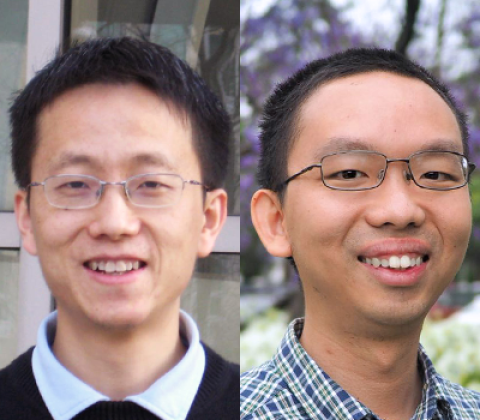
Liang Feng, Molecular & Cellular Physiology
Xiaojing Gao, Chemical Engineering
Abstract:
Proteins on the surface of our cells play important roles, such as controlling what goes in and out and relay critical signals. They are essential for health and are the target of most modern medicines. To work correctly, these proteins must change their physical shape, much like a machine with moving parts. However, capturing and selectively targeting these different shapes is extraordinarily difficult. Current methods for "freezing" a protein in one shape are often slow, expensive, and rely on luck, creating a major roadblock in drug discovery.
Our research proposes a powerful, two-part strategy using artificial intelligence (AI) to overcome this challenge. First, we use a new AI tool we developed to predict all the likely shapes a protein can take. Second, for each predicted shape, we use another AI to design a custom-made "molecular clamp" (a nanobody) that is built to grab and hold the protein in that one specific shape.
We will test this method on a critical anti-cancer drug target. Using AI-predicted conformations and designed nanobody clamps, we will capture distinct functional states for high-resolution 3D structural analysis and test how stabilizing each state alters activity. By visualizing these stabilized shapes, we will build a mechanistic model of how the protein functions, and by modulating its activity, generate a powerful and selective tool with strong therapeutic potential in cancer. Beyond advancing this specific target, the project will establish a revolutionary new workflow that could help scientists everywhere study any shape-shifting protein and accelerate the design of new medicines.