Interdisciplinary Initiatives Program Round 13 - 2026
Project Investigators:
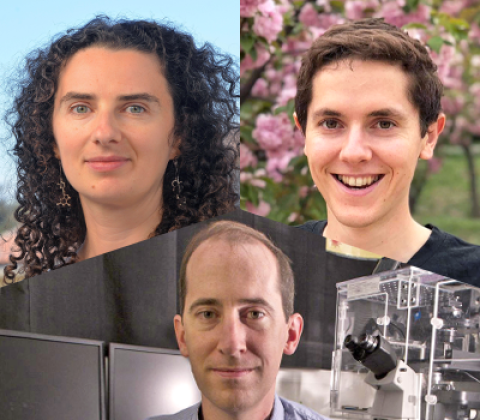
Lacramioara Bintu, Bioengineering
Grant Rotskoff, Chemistry
Alexander Dunn, Chemical Engineering
Abstract:
The conversion of information stored in the human genome into the proteins that make up a cell depends on transcription factors (TFs), which control whether a gene is transcribed into messenger RNA, and RNA-binding proteins (RBPs), which control the rate at which that messenger RNA is translated into protein or degraded. Both TFs and RBPs rely heavily on intrinsically disordered regions (IDRs) to do their jobs. Unlike folded protein domains, IDRs do not adopt a single stable shape. Despite this lack of fixed structure, IDRs help determine where TFs and RBPs localize in the cell and which partners they recruit. Recently, the Bintu Lab has discovered thousands of new effector domains (activators, repressors, and RNA downregulators) that overlap with IDRs in TFs and RBPs, underscoring the pervasive importance of IDRs in regulating gene expression. However, we do not yet know how to connect their protein sequence to function.
Recent machine-learning advances have revolutionized the prediction of folded protein structure and function. In contrast, comparable tools do not yet exist for IDRs, whose flexibility demands fundamentally different approaches. Here, we propose a new collaboration between the Bintu, Dunn, and Rotskoff Labs to build predictive, mechanistic models of IDR function. We will integrate (i) the Bintu Lab’s high-throughput cell-based assays that measure gene activation, repression, RNA downregulation and cellular localization across large protein libraries, (ii) machine-learning methods developed by the Rotskoff Lab, and (iii) protein biophysical measurements from the Dunn Lab to create an IDR-focused protein language model that predicts key functional properties of existing IDRs and generates new IDRs that program subcellular localization and regulatory output.
This project will deliver quantitative insight into the rules that connect an IDR’s amino acid sequence to what it does in cells, including where it localizes, how it recognizes its binding partners, and how these interactions regulate gene transcription and translation. Success here will lay the foundation for a predictive understanding of how cancer-associated mutations disrupt gene and RNA regulation and will lay the groundwork for designing new therapies that modulate IDR-driven interactions to treat disease.