
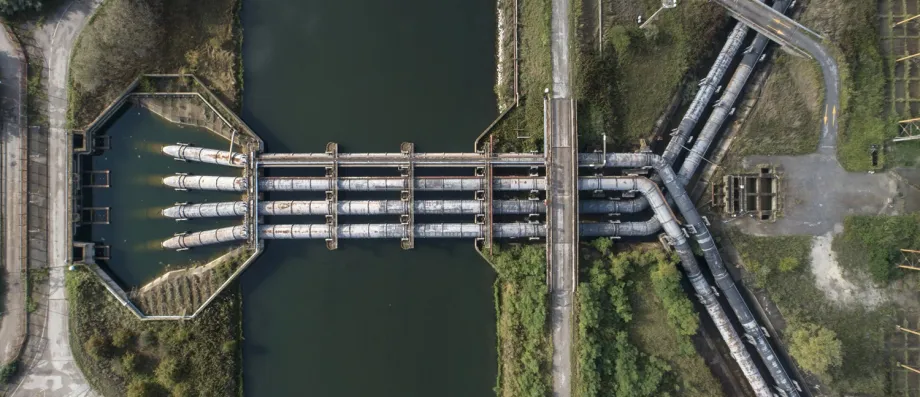
Withdrawing a million gallons from a water-rich region is not equivalent to withdrawing it from a drought-stricken basin, but existing metrics often fail to capture this nuance. | Getty Images
Stanford Report News - February 19th, 2026
Thousands of companies around the world now regularly disclose aspects of their water use as part of corporate commitments to environmental, social, and governance goals. Yet reliable measures of corporate water withdrawals and discharges – and their impacts on local water quality and ecosystems – have been limited.
In a Feb. 16 perspective article in Nature Water, researchers from Stanford University, Korea University, and the International ESG Association in Seoul outlined a new “water sustainability index,” or WSI, as a possible solution.
The index is a new metric that considers the volume and source water type for watershed withdrawals, the volume and quality of wastewater discharges, the volume of water consumed, and the extent to which facilities reuse water. The team developed weighting factors based on the stress level of the watershed where a company is drawing its water.
“We’ve created, essentially, a financial calculator for water sustainability. A company can plug in different scenarios – relocating a facility, upgrading wastewater treatment, implementing recycling – and see how much their score would improve before spending a dollar,” said study co-author William Mitch, a professor of civil and environmental engineering at Stanford University.
The impetus for the new index emerged from what the researchers saw as a stark data disparity. Analyzing data from the London Stock Exchange Group, Mitch and co-authors Yoora Cho, Jay Hyuk Rhee, and Yong Sik Ok found that while 14% of major companies reported their greenhouse gas emissions, only 9% provided explicit data on total water withdrawals. Even more telling, only 1% disclosed whether their operations utilized recycled water.
While carbon dioxide emissions are a global issue, water is an intensely local one. Withdrawing a million gallons from a water-rich region is not equivalent to withdrawing it from a drought-stricken basin. Existing environmental, social, and governance, or ESG, metrics often fail to capture this nuance, hindered by non-uniform and opaque algorithms that vary substantially across reporting entities.
A weighted approach to scarcity
The new index moves beyond simple volume tracking. It calculates a score based on the volume and type of source water, the degree of water stress in the local watershed, wastewater discharge quality, total consumption, and the extent of reuse.
The formula applies higher weights to operations located in stressed watersheds – defined as regions where withdrawals exceed 40% of available freshwater – and to the use of groundwater, which is more difficult to replenish than surface water. This penalizes facilities that deplete scarce local resources while rewarding those that invest in sustainable improvements.
To demonstrate the index’s efficacy, the team ran seven theoretical scenarios. In one scenario, a company pumps groundwater from a stressed area and discharges low-quality wastewater. This theoretical company would earn a dismal score of 1.17. The study found that while moving the facility to an unstressed area improved the score, the most dramatic gains came from technological intervention. Implementing internal process-water reuse could raise its score to 1.98. By combining relocation, water quality upgrades, and internal reuse, the score hit a maximum of 3.0.
The “quantitative and transparent nature” of the new index “helps corporations identify cost-effective investments to improve water sustainability," the researchers write. It allows companies to calculate the anticipated increase in their score under different scenarios before committing capital.
The researchers envision the index as a bridge between the complex scientific evaluations of internationally recognized industry standards and the practical needs of current voluntary reporting. By providing a single, reproducible number, the index could eliminate the widely divergent ratings that currently see the same company receive an “A” from one ESG provider and a “D” from another.
“The fact that companies can get wildly different ratings for the exact same water practices is not only confusing for investors and well-intentioned companies, it also enables greenwashing. Our index uses transparent, reproducible math that anyone can verify,” Mitch said.
As global water stress intensifies, with 25% of the population already living in extremely high-stress watersheds, the WSI offers a standardized language for a resource that has long been undervalued.
“Moving toward a transparent and quantitative water sustainability metric should facilitate cost-effective corporate investments,” the authors write.
This article was adapted from a press release originally published by Korea University.
Civil & Environmental Engineering is a joint department of the Stanford Doerr School of Sustainability and the School of Engineering. Cho is a visiting PhD student in the Mitch Lab at Stanford and a PhD candidate at Korea University.
This work was supported by a grant from the National Research Foundation of Korea and by a Korea University Business School Research Grant.