
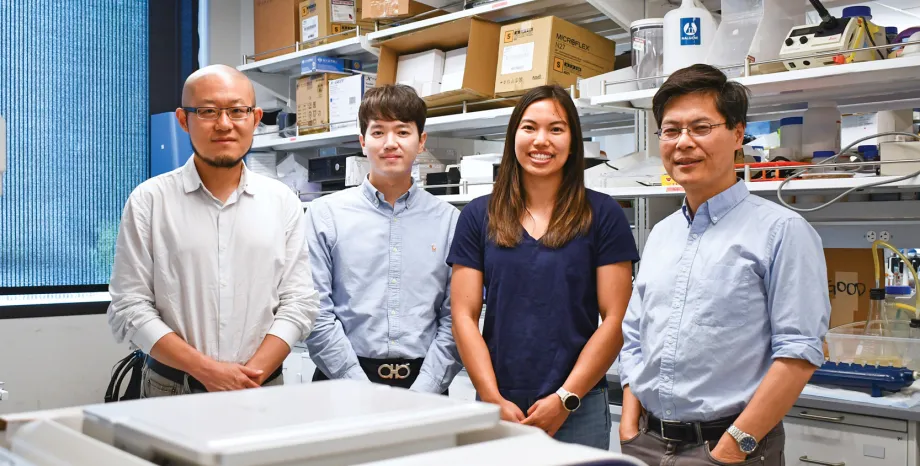
From left: Dr. Guosong Hong, Dr. Daesun Song, Marigold Malinao, and Dr. Michael Lin.

Graphical Abstract
Stanford Bio-X affiliated faculty members Michael Lin, Guosong Hong, and Hanlee Ji, with co-authors Stanford Bio-X Fellow Marigold Malinao, Stanford Bio-X Fellow Sa Cai, and Stanford Bio-X/Novo Nordisk Foundation Visiting Scholar Michael Westberg, with first author Dr. Daesun Song, have demonstrated successful gene editing in the targeted skeletal muscle and brain regions of mice using adeno-associated virus (AAV)-transduced psCas12f and focused ultrasound (FUS) – a completely noninvasive method for localized gene editing in vivo. This work was partially supported by a Stanford Bio-X Seed Grant titled Ultrasound-controlled in vivo gene editing via photoswitchable CRISPR-Cas9.
A spatiotemporally controllable CRISPR-Cas system would be highly desirable for restricting gene editing to specific times and locations in vivo. Ideally, such a system would be compatible with tissue- or cell-type-specific delivery by adeno-associated virus (AAV) and could be controlled from outside the body. However, neither the delivery of controllable CRISPR-Cas systems by single AAV particles nor their noninvasive activation deep within tissue has yet been achieved. In this study, we address both of these limitations.