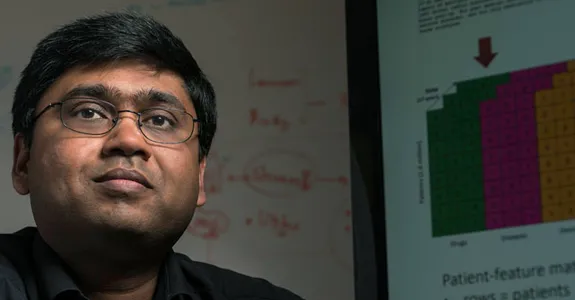

Dr. Nigam Shah is Professor of Medicine at Stanford University, and Chief Data Scientist for Stanford Health Care. His research group analyzes multiple types of health data (EHR, Claims, Wearables, Weblogs, and Patient blogs), to answer clinical questions, generate insights, and build predictive models for the learning health system. At Stanford Healthcare, he leads artificial intelligence and data science efforts for advancing the scientific understanding of disease, improving the practice of clinical medicine and orchestrating the delivery of health care.
Dr. Shah is an inventor on eight patents and patent applications, has authored over 200 scientific publications and has co-founded three companies. Dr. Shah was elected into the American College of Medical Informatics (ACMI) in 2015 and was inducted into the American Society for Clinical Investigation (ASCI) in 2016. He holds an MBBS from Baroda Medical College, India, a PhD from Penn State University and completed postdoctoral training at Stanford University.
In the past, Dr. Shah's lab developed methods to analyze multiple datatypes for generating insights. Such as: Detecting skin adverse reactions by analyzing content in a health social network, enabling medical device surveillance, discovering drug adverse events as well as drug-drug interactions from clinical notes using novel methods for processing textual documents. Inferring physical function from wearables data, predicting healthcare utilization from Web search logs and understanding information seeking behavior of health professionals.
Their current research is focused on bringing AI into clinical use, safely, ethically and cost effectively. Research on Responsible AI (https://rail.stanford.edu/) is translated into practice by the Data Science team at Stanford Healthcare. This work is organized in two broad work-streams.
(1) Creation and adoption of foundation models in medicine: Given the high interest in using large language models (LLMs) in medicine, the creation and use of LLMs in medicine needs to be actively shaped by provisioning relevant training data, specifying the desired benefits, and evaluating the benefits via testing in real-world deployments.
(2) Making machine learning models clinically useful: Whether a classifier or prediction model is useful in guiding care depends on the interplay between the model's output, the intervention it triggers, and the intervention’s benefits and harms. The Shah lab's work stemmed from the effort in improving palliative care using machine learning. Blog posts at HAI summarize our work in easily accessible manner.