
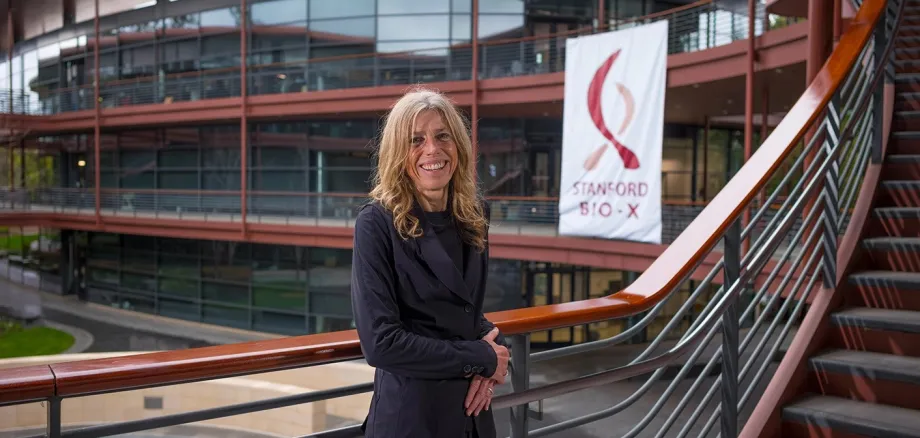
Ellen Kuhl named director of Stanford Bio-X
March 29, 2024 - Stanford News
Kuhl aims to continue Bio-X’s legacy of facilitating multidisciplinary fundamental research and innovation.
Stanford Bio-X affiliated faculty members and fellows are generating scientific advances that expand our understanding of how the body works and will ultimately improve human health. These news stories and press releases describe some of those breakthroughs.
March 29, 2024 - Stanford News
Kuhl aims to continue Bio-X’s legacy of facilitating multidisciplinary fundamental research and innovation.
March 18, 2015 - Stanford Report
A computer model of brain function, developed under Bio-X affiliates Bill Newsome, Kwabena Boahen, and Tirin Moore, helps explain a 20-year-old finding that the way a single noisy neuron fires in the brain can predict an animal's decisions.
March 16, 2015 - Stanford Medicine News Center
Researchers under Bio-X affiliated faculty member Ravindra Majeti found a method that can force dangerous leukemia cells to mature into harmless immune cells.
March 16, 2015 - Stanford Report
Stanford bioengineers under Bio-X affiliated faculty member KC Huang have created a time-lapse video that shows this process of how bacteria essentially go undercover in ways that might trick the human immune system.
March 11, 2015 - Stanford Report
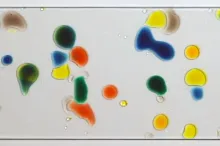
In Bio-X affiliated faculty member Manu Prakash's lab, years of research satisfy a graduate student's curiosity about the molecular minuet he observed among drops of ordinary food coloring.
March 9, 2015 - Stanford Medicine News Center
A newly developed genetic technique enabled researchers under Bio-X affiliated faculty member Carlos Bustamante to sequence DNA from the teeth of 300-year-old skeletons, helping to pinpoint where in Africa three slaves had likely lived before being captured.
March 9, 2015 - Stanford Medicine News Center
Basal cell carcinomas develop mutations in a protein on the Hedgehog pathway to evade a common drug therapy. Bio-X affiliated faculty members Anthony Oro and Jean Tang are targeting another portion of the pathway, may be an alternative treatment.
March 9, 2015 - Stanford Medicine News Center
A free iPhone app, launched by Bio-X affiliated faculty Michael McConnell and Euan Ashley, allows users to contribute to a study of human heart health while learning about the health of their own hearts.
March 4, 2015 - Stanford Medicine News Center
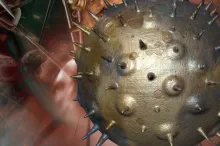
With help from Bio-X affiliated faculty members Chaitan Khosla and Daria Mochly-Rosen, blocking the expression of a gene that inadvertently promotes cancer growth could help prevent the growth of many types of tumors.
March 4, 2015 - Stanford Report
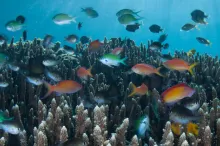
A study by Bio-X affiliated faculty member Jonathan Payne refutes a hypothesis by the famed evolutionary biologist Stephen J. Gould.
February 25, 2015 - Stanford Medicine News Center
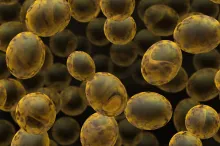
Bio-X affiliated faculty members Gavin Sherlock, Dmitri Petrov, and Daniel Fisher, partially supported by a 2012 Bio-X IIP Seed Grant, have developed a technique for understanding how cancer cells evolve or how a virus spreads and changes.
February 23, 2015 - Stanford Medicine News Center
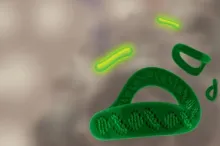
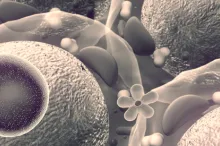
Bio-X affiliated faculty member Sam Gambhir's group finds that tiny DNA rings, carrying instructions for making a blood-detectable biomarker, can enter both healthy cells and cancer cells. But only cancer cells follow the recipe to make the biomarker.
February 23, 2015 - Stanford Medicine News Center
Scientists under Bio-X affiliated faculty member Daria Mochly-Rosen have shown that small molecules can “hijack” enzyme function in mice, suggesting a possible preventive mechanism for alcohol-related cancers in an at-risk population.
February 19, 2015 - Stanford Medicine News Center
Research led by Bio-X affiliated faculty members David Camarillo, Jaime Lopez, and Gerald Grant, with 2014 Bio-X Bowes Fellow Lyndia Wu and 2010 Bio-X Bowes Fellow Michael Yip, could eventually lead to better concussion detection and prevention.

February 19, 2015 - Stanford Report
Stanford ChEM-H scientists, including Bio-X affiliated faculty member Chaitan Khosla, are helping to develop a novel cancer therapy based on a new finding of a protein that inadvertently promotes cancer growth.
February 19, 2015 - Stanford Report
New Stanford research under Bio-X affiliated faculty member Jonathan Payne shows that animals tend to evolve toward larger body sizes over time. Over the past 542 million years, the mean size of marine animals has increased 150-fold.
February 18, 2015 - Stanford Medicine News Center
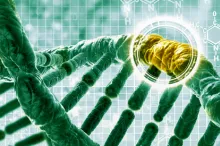
A new reference map developed by Bio-X affiliated faculty member Anshul Kundaje will help interpret the genetic basis for disease.
February 18, 2015 - Stanford Report
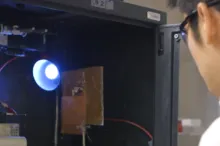
Bio-X affiliated faculty member Yi Cui's group has turned a material commonly used in surgical gloves into a low-cost, highly efficient air filter. It could be used to improve facemasks and window screens, and maybe even scrub exhaust from power plants.
February 12, 2015 - Stanford Medicine News Center
Researchers under Bio-X affiliated faculty members Anne Brunet and Steven Artandi disabled aging-associated genes in the short-lived African killifish, including one for an enzyme called telomerase, whose absence caused humanlike disease in the animal.

February 12, 2015 - Stanford Medicine News Center
Researchers under Bio-X affiliate Tobias Meyer have developed a search engine to help identify human gene function by comparing human genes to nonhuman genes.
February 10, 2015 - Stanford Medicine News Center
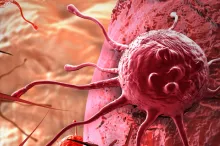
A new model by Bio-X affiliate Christina Curtis's group of how colon tumors grow emphasizes the importance of time and the early origin of differences among tumors.
February 3, 2015 - Stanford Medicine News Center
Researchers under Bio-X affiliated faculty member Seung Kim, including Bio-X Bowes Fellow Ron Alfa, have identified a hormone that decreases insulin production during starvation in fruit flies and humans.
February 2, 2015 - Stanford Report
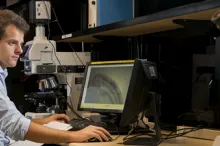
2013 and 2011 Bio-X Undergraduate Fellow Richie Sapp was part of a team under Bio-X Director Carla Shatz whose research could make it easier for adults to learn and possibly heal after brain injuries.
January 30, 2015 - Stanford Report
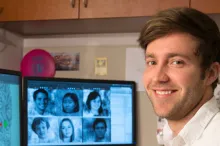
Differences in connectivity in the brain predict face blindness in adults, say Stanford neuroscientists under Bio-X affiliated faculty Kalanit Grill-Spector and Brian Wandell.

January 26, 2015 - Stanford Report
By selectively manipulating how DNA issues biological commands, Stanford bioengineers under Bio-X affiliated faculty member Lei Stanley Qi have developed a tool that could prove useful in future gene therapies.
January 23, 2015 - Stanford Medicine News Center
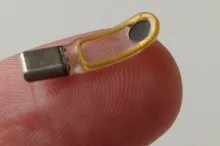
A search for medical needs in eye clinics led a Stanford Biodesign fellow, mentored by Bio-X affiliated faculty members Mark Blumenkranz and Daniel Palanker, to develop an implantable neurostimulator that painlessly increases natural tear production.
January 23, 2015 - Stanford Medicine News Center
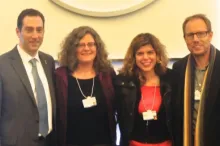
Members of teams created through the Stanford Neurosciences Institute's Big Ideas in Neuroscience initiative, including Bio-X affiliated faculty members Amit Etkin, Marion Buckwalter, Anne Brunet and Tony Wyss-Coray, spoke at the World Economic Forum.
January 22, 2015 - Stanford Medicine News Center
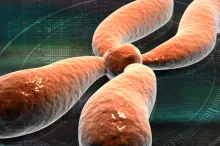
Researchers under Bio-X affiliated faculty members Helen Blau, John Cooke, and Juan Santiago, including 2010 Bio-X Skippy Frank Fellow Jennifer Brady, delivered a modified RNA that encodes a telomere-extending protein to cultured human cells.

January 16, 2015 - Stanford Report
Bio-X affiliated faculty member Steve Palumbi shows that the industrialization of the oceans mirrors the early stages of activities that triggered mass extinctions on land.
January 15, 2015 - Stanford Medicine News Center
The discovery, under Bio-X affiliated faculty members Michael Longaker, Irv Weissman, and Calvin Kuo, of a skeletal stem cell in mice sets the stage for new methods to grow cartilage and bone for use in medical therapies.
January 15, 2015 - Stanford Report
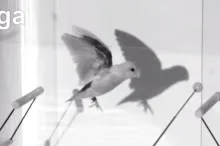
A new device invented by Bio-X affiliated faculty member David Lentink will answer long-held questions about the forces birds generate while flying, and could lead to the development of innovative, efficient unmanned aerial vehicles.