
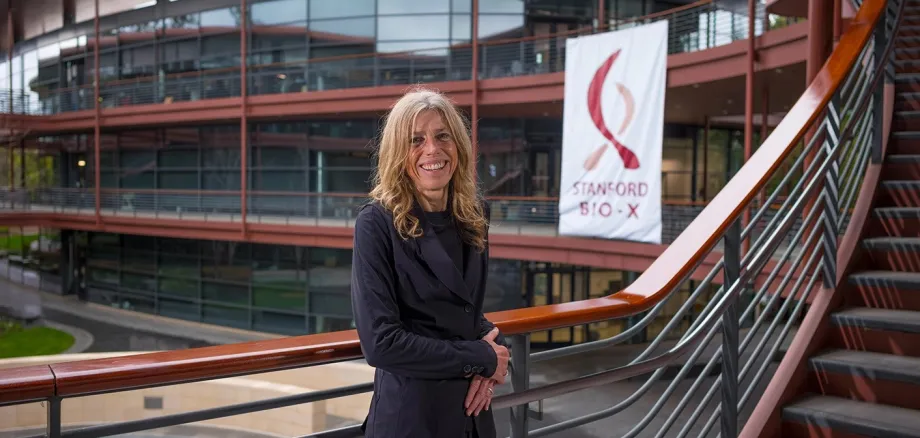
Ellen Kuhl named director of Stanford Bio-X
March 29, 2024 - Stanford News
Kuhl aims to continue Bio-X’s legacy of facilitating multidisciplinary fundamental research and innovation.
Stanford Bio-X affiliated faculty members and fellows are generating scientific advances that expand our understanding of how the body works and will ultimately improve human health. These news stories and press releases describe some of those breakthroughs.
March 29, 2024 - Stanford News
Kuhl aims to continue Bio-X’s legacy of facilitating multidisciplinary fundamental research and innovation.
April 18, 2016 - Stanford News
Researchers under Bio-X affiliates Zhenan Bao and Christian Linder show how jolting this material with an electrical field causes it to twitch or pulse in a muscle-like fashion.
April 18, 2016 - Stanford Medicine News Center
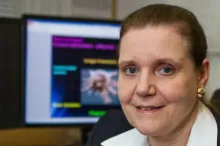
Bio-X affiliates Cornelia Weyand and Jorg Goronzy find that deficits in a recently discovered immune cell’s function may trigger a rare age-related auto-inflammatory disease — and perhaps far more common ones, too.
April 18, 2016 - Stanford Medicine News Center
Bio-X affiliates Joseph Wu, Joshua Knowles, Helen Blau, Daniel Bernstein, and Russ Altman are studying the phenomenon of doxorubicin, a chemotherapy drug, causing serious heart damage in some patients.

April 13, 2016 - Stanford News
Targeting psychology may promote environmentally friendly choices in individual practices and national policies, scientists including Bio-X affiliate Marcus Feldman say.
April 14, 2016 - Stanford News
Wikipedia exists in nearly 300 languages but many versions are small and incomplete. In one experiment, computer scientists under Bio-X affiliate Jurij Leskovec tripled article creation by recommending missing entries to editors.
April 12, 2016 - Stanford Engineering
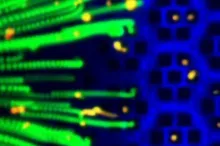
A team of researchers under Bio-X affiliates Shan Wang, Samuel So, and Sam Gambhir tracks disease the way naturalists track animals in the wild.
April 12, 2016 - Stanford Engineering
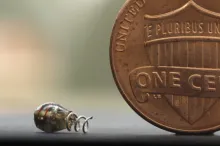
Inspired by personal experience, Bio-X affiliate Ada Poon pioneers the development of ‘electroceuticals’ that can dispense treatments or monitor functions deep inside the body.
April 8, 2016 - Stanford Medicine News Center
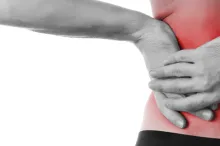
Bio-X affiliate Sean Mackey and his colleagues created a computer-based system that uses streams of data from many patients to help physicians provide the best care for individuals.

April 7, 2016 - Stanford Medicine News Center
The implications of emerging biotechnologies and what they mean for human reproduction and making babies raises legal, ethical and social issues, according to Bio-X affiliate Hank Greely.
April 7, 2016 - Stanford Medicine News Center
Bio-X affiliate Carlos Bustamante finds that the Neanderthal counterpart of the human Y chromosome, or male sex chromosome, appears to have died out. Why this happened is up for debate.

April 5, 2016 - Stanford Report
Bio-X affiliate Elizabeth Hadly finds that when humans colonized South America, their populations grew like a typical invasive species – an initial explosive growth rapidly reached the environment's carrying capacity.
April 4, 2016 - Stanford Medicine Scope
A new study led by Bio-X affiliate Jorg Goronzy provides evidence as to why a single shot is insufficient for roughly half of those vaccinated for shingles.
April 1, 2016 - Stanford Medicine News Center
The new center, directed by Bio-X affiliate Markus Covert with Bio-X affiliates KC Huang and Denise Monack as co-investigators, will explore intracellular and intercellular processes by which salmonella bacteria infect immune cells.
April 1, 2016 - Stanford Medicine Scope
Bio-X affiliate Ronald Levy and his colleagues wondered what would happen if they combined immunotherapy and targeted therapies as an alternative to chemotherapy.
March 31, 2016 - Stanford News
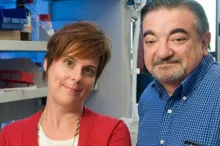
Bio-X affiliate Jennifer Cochran and Amato Giaccia, initially supported by a Bio-X Seed Grant, find that creating a molecular snapshot of the way proteins interact could help development of new cancer drugs.

March 31, 2016 - Stanford News
Bio-X affiliates Nicholas Melosh, Jelena Vuckovic, and Steven Chu find that precisely flawed nanodiamonds could produce next-generation tools for imaging and communications.
March 28, 2016 - Stanford Medicine News Center
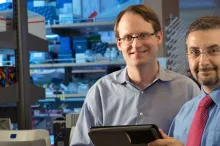
A new way to quiet background “noise” in blood samples allows researchers under Bio-X affiliates Maximilian Diehn, Ash Alizadeh, Robert West, and Billy Loo to sequence minute quantities of tumor DNA from cancers to improve diagnosis and treatment.
March 28, 2016 - Stanford Medicine News Center
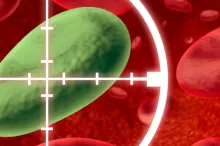
Bio-X affiliates Chaitan Khosla, Jeffrey Glenn, Jan Carette, and Michael Bassik found that a discarded drug helps human cells in a lab dish fight off two different viruses. This might also help fight the viruses that cause Ebola, dengue and Zika, among others.
March 28, 2016 - Stanford Medicine Scope
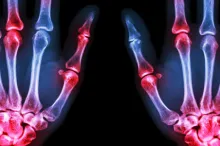
Bio-X affiliate Connie Weyand and her colleagues have figured out what sparks the aberrant activation of the immune cells driving the angry inflammation and tissue damage that mark rheumatoid arthritis, an autoimmune disease.

March 25, 2016 - Stanford Engineering
Bio-X affiliate Russ Altman mines patient data to discover unreported side effects of drugs, and paves a path to future medical breakthroughs.

March 24, 2016 - Stanford Medicine News Center
A phone app developed under Bio-X affiliate Euan Ashley to study heart disease risk and help ordinary people manage that risk has teamed up with 23andMe to add a genetics option.
March 24, 2016 - Stanford Medicine News Center
Steroid treatments intended to mature premature infants’ lungs before birth also protect them against brain hemorrhages after they are born, according to a California-wide study by Bio-X affiliate Henry Lee.
March 23, 2016 - Stanford Medicine News Center
Bio-X affiliates Karl Deisseroth and Brian Knutson found that when rats were trained to choose between high- and low-risk options while a circuit in their brains was monitored and manipulated, a specific signal in that circuit determined their choice.
March 23, 2016 - Stanford Earth Matters
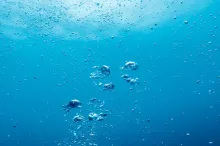
Bubbles could help protect coral reefs, oyster farms, and other coastal ecosystems from increasing ocean acidification, according to new research by Bio-X affiliate Rob Dunbar.
March 22, 2016 - Stanford Report
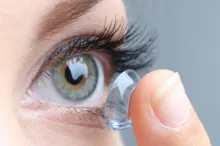
Chemical engineers under Bio-X affiliate Gerald Fuller have discovered mechanical properties of the tear film on the eye's surface that can be used to manufacture contact lenses that more closely mimic the eye.

March 21, 2016 - Stanford Engineering
An interdisciplinary research team under Bio-X affiliates Paul Wender, Christina Smolke, and Elizabeth Sattely shows how we just might be able to grow more plentiful and better medicines in the lab.
March 18, 2016 - Stanford Engineering
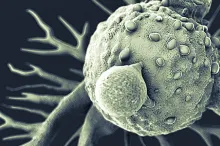
A group of researchers under Bio-X affiliates Sam Gambhir, Shan Wang, and Jianghong Rao shows how nanomedicine is changing the path of cancer diagnosis and treatment.
March 18, 2016 - Stanford Report
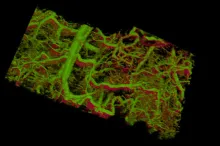
Partially supported by a Bio-X IIP Seed Grant, a team under Bio-X affiliate Adam de la Zerda, including Bio-X Bowes Fellow Orly Liba, developed the first technique for viewing cells and tissues in three dimensions under the skin. The work could improve diagnosis and treatment for some forms of cancer and blindness.
March 18, 2016 - Stanford Report
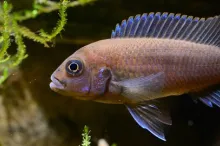
By studying the complex mating routine of African cichlid fish, a team of scientists under Bio-X affiliates Russell Fernald and Philippe Mourrain has keyed in on a single brain receptor in female fish that determines whether they successfully reproduce.

March 15, 2016 - Stanford Medicine News Center
Bio-X affiliate John Ioannidis finds in a review of p-values in the biomedical literature from 1990 to 2015 that these widely misunderstood statistics are being used increasingly, instead of better metrics of effect size or uncertainty.